Discover our research
At TRR 418, our research reveals new insights in circadian medicine. These discoveries are shared through our publications, offering a closer look at experimental, clinical, and data-driven studies that help us understand how circadian timing affects health and disease. Dive into our publications to see the evidence, methods, and ideas.
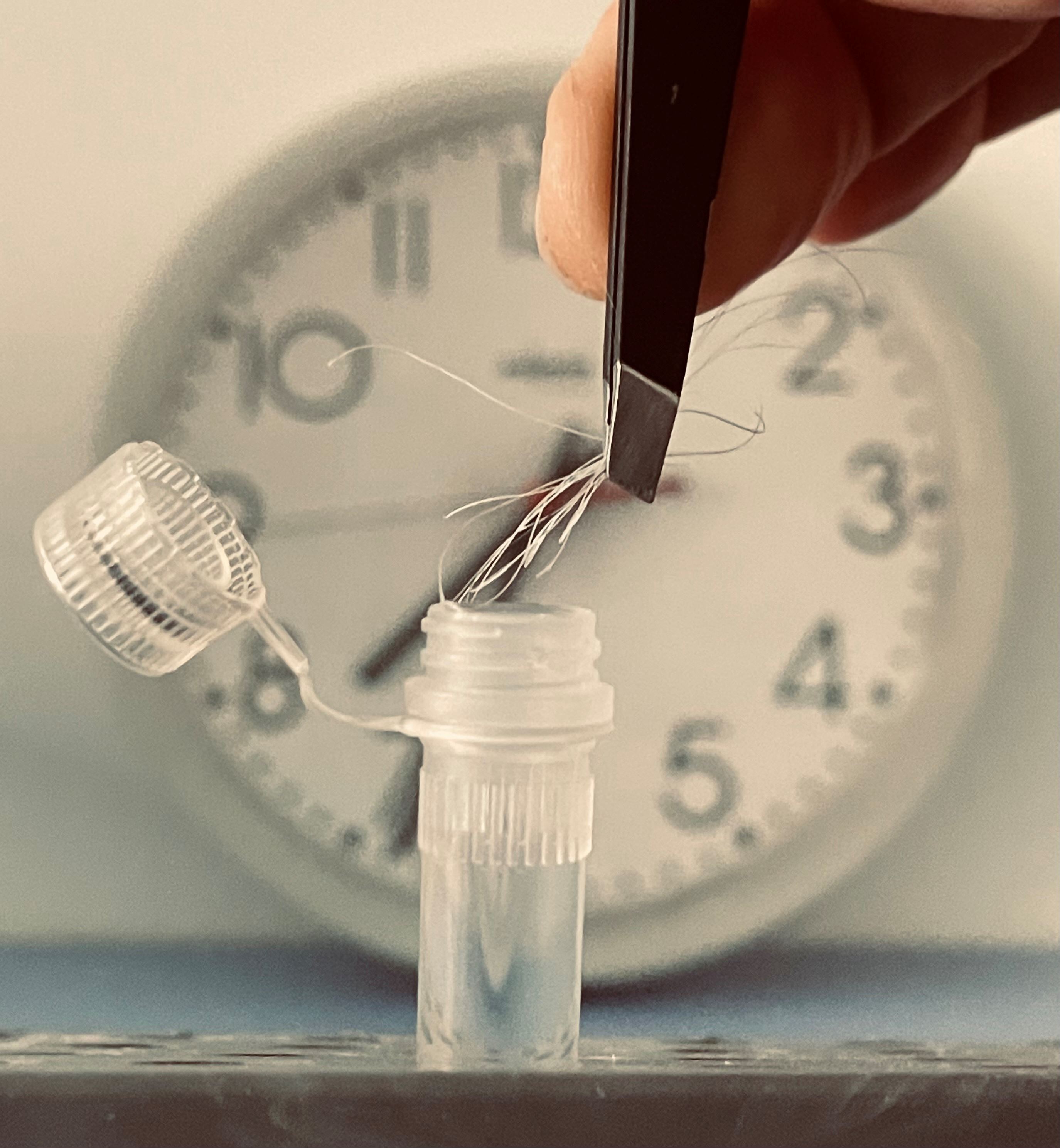
HairTime: A noninvasive assay for estimating circadian phase from a single hair sample
March 25, 2026
•
Proc Natl Acad Sci USA
Circadian clocks govern daily physiological and behavioral processes and are crucial for health; disruptions can lead to various diseases. The circadian phase of entrainment—the phase of the internal circadian clock in relation to external environmental cycles—is influenced by both genetic and environmental factors, varies between individuals, and is reflected in daily behaviors such as sleep–wake patterns, cognitive performance, and physical activity. While circadian phase may also fluctuate within individuals, the dynamics and extent of such variation in daily life remain largely unexplored. The gold standard for circadian phase assessment, dim-light melatonin onset (DLMO), is impractical for large-scale studies, and blood-based molecular biomarkers, while promising, are limited in feasibility. To address these challenges, we developed HairTime, a noninvasive assay that estimates circadian phase from a single daytime hair sample. Developed and evaluated in two steps—a training and a validation study—HairTime demonstrated strong predictive power compared to DLMO. Suitable for large-scale studies, it was assessed using over 4,000 samples. Circadian phase estimations showed a normal distribution and were associated with age, sex, and notably, work schedules, with earlier timing on workdays, suggesting that societal factors can modulate internal rhythms. Together, these findings establish HairTime as a promising tool for assessing circadian phase in research and lay the foundation for future applications in personalized chronotherapy.
HairTime: A noninvasive assay for estimating circadian phase from a single hair sample
March 25, 2026
•
Proc Natl Acad Sci USA
Circadian clocks govern daily physiological and behavioral processes and are crucial for health; disruptions can lead to various diseases. The circadian phase of entrainment—the phase of the internal circadian clock in relation to external environmental cycles—is influenced by both genetic and environmental factors, varies between individuals, and is reflected in daily behaviors such as sleep–wake patterns, cognitive performance, and physical activity. While circadian phase may also fluctuate within individuals, the dynamics and extent of such variation in daily life remain largely unexplored. The gold standard for circadian phase assessment, dim-light melatonin onset (DLMO), is impractical for large-scale studies, and blood-based molecular biomarkers, while promising, are limited in feasibility. To address these challenges, we developed HairTime, a noninvasive assay that estimates circadian phase from a single daytime hair sample. Developed and evaluated in two steps—a training and a validation study—HairTime demonstrated strong predictive power compared to DLMO. Suitable for large-scale studies, it was assessed using over 4,000 samples. Circadian phase estimations showed a normal distribution and were associated with age, sex, and notably, work schedules, with earlier timing on workdays, suggesting that societal factors can modulate internal rhythms. Together, these findings establish HairTime as a promising tool for assessing circadian phase in research and lay the foundation for future applications in personalized chronotherapy.
Insomnia increases the risk for specific autoimmune diseases: a large-scale retrospective cohort study
April 10, 2025
•
Frontiers in Network Physiology
Sarah Stenger, Artem Vorobyev, Katja Bieber, Tanja Lange, Ralf J Ludwig , Jennifer E Hundt
Objective: The global rise of autoimmune diseases presents a significant medical challenge, with inadequate treatment options, high morbidity risks, and escalating healthcare costs. While the underlying mechanisms of autoimmune disease development are not fully understood, both genetic predispositions and lifestyle factors, particularly sleep, play critical roles. Insomnia and circadian rhythm sleep disorders not only impair sleep but also disrupt multi-organ interactions by dysregulating sympathetic nervous system activity, altering immune responses, and influencing neuroendocrine function. These disruptions can contribute to immune system dysregulation, increasing the risk of autoimmune disease development.
Methods: To assess the impact of impaired sleep on the risk of developing autoimmune diseases, a global population-based retrospective cohort study was conducted using electronic health records from the TriNetX US Global Collaborative Network, including 351,366 subjects in each propensity score matched group. Twenty autoimmune diseases were examined, and propensity score matching was employed to reduce bias. Three sensitivity analyses were conducted to test the robustness of the results.
Results: The study identified significantly increased risks for several autoimmune diseases associated with impaired sleep, likely mediated by dysregulated neuroimmune and autonomic interactions. Specifically, cutaneous lupus erythematosus [hazard ratio (HR) = 2.119; confidence interval (CI) 1.674-2.682; p < 0.0001], rheumatoid arthritis (HR = 1.404; CI 1.313-1.501; p < 0.0001), Sjögren syndrome (HR = 1.84; CI 1.64-2.066; p < 0.0001), and autoimmune thyroiditis (HR = 1.348; CI 1.246-1.458; p < 0.0001) showed significantly increased risks. No diseases demonstrated reduced risks, and 4 out of 20 tested diseases did not show significant HR increases in any analysis.
Conclusion: This study highlights the integral role of sleep in maintaining immune homeostasis through multi-organ interactions involving the autonomic nervous system, immune signalling pathways, and endocrine regulation. Disruptions in these systems due to chronic sleep impairment may predispose individuals to autoimmune diseases by altering inflammatory responses and immune tolerance. These findings underscore the necessity of recognizing and treating sleep disorders not only for general wellbeing but also as a potential strategy to mitigate the long-term risk of autoimmune disease development.
Keywords: TriNetX; autoimmune diseases; autoimmunity; insomnia; retrospective cohort study; sleep.
Time-of-day dependency of adoptive cell therapies
October 31, 2025
•
Trends in Cancer
Constant Adriaan Tellinga, Roman Friedli, Federico Simonetta, Christoph Scheiermann
Adoptive cell therapies (ACTs), such as chimeric antigen receptor (CAR)-T cell therapy, have revolutionized cancer treatment, especially for hematological cancers. However, patient responses vary considerably. Emerging research reveals a striking influence of time of day (ToD) on ACT efficacy. Administering ACT during the early behavioral active phase enhances tumor control and reduces toxicity in preclinical models, an effect linked to the circadian clock. Latest clinical data also point to ToD effects in the cancer setting. In this opinion article we explore current insights and discuss the emerging underlying mechanisms. We propose that integrating ToD into clinical practice could represent a powerful yet easily implementable therapeutic regimen to improve efficacy and safety of ACT.
Circadian tumor infiltration and function of CD8+ T cells dictate immunotherapy efficacy
May 23, 2024
•
Cell
Chen Wang, Qun Zeng, Zeynep Melis Gül, Sisi Wang, Robert Pick, Phil Cheng, Ruben Bill, Yan Wu, Stefan Naulaerts, Coline Barnoud, Pei-Chun Hsueh, Sofie Hedlund Moller, Mara Cenerenti, Mengzhu Sun, Ziyang Su, Stéphane Jemelin, Volodymyr Petrenko, Charna Dibner, Stéphanie Hugues, Camilla Jandus, Zhongwu Li, Olivier Michielin, Ping-Chih Ho, Abhishek D Garg, Federico Simonetta, Mikaël J Pittet, Christoph Scheiermann
The quality and quantity of tumor-infiltrating lymphocytes, particularly CD8+ T cells, are important parameters for the control of tumor growth and response to immunotherapy. Here, we show in murine and human cancers that these parameters exhibit circadian oscillations, driven by both the endogenous circadian clock of leukocytes and rhythmic leukocyte infiltration, which depends on the circadian clock of endothelial cells in the tumor microenvironment. To harness these rhythms therapeutically, we demonstrate that efficacy of chimeric antigen receptor T cell therapy and immune checkpoint blockade can be improved by adjusting the time of treatment during the day. Furthermore, time-of-day-dependent T cell signatures in murine tumor models predict overall survival in patients with melanoma and correlate with response to anti-PD-1 therapy. Our data demonstrate the functional significance of circadian dynamics in the tumor microenvironment and suggest the importance of leveraging these features for improving future clinical trial design and patient care.
Circadian Rhythms in Anticancer Immunity: Mechanisms and Treatment Opportunities
June 30, 2024
•
Annual Review of Immunology
Robert Pick, Chen Wang, Qun Zeng, Zeynep Melis Gül, Christoph Scheiermann
Circadian rhythms of approximately 24 h have emerged as important modulators of the immune system. These oscillations are important for mounting short-term, innate immune responses, but surprisingly also long-term, adaptive immune responses. Recent data indicate that they play a central role in antitumor immunity, in both mice and humans. In this review, we discuss the evolving literature on circadian antitumor immune responses and the underlying mechanisms that control them. We further provide an overview of circadian treatment regimens—chrono-immunotherapies—that harness time-of-day differences in immunity for optimal efficacy. Our aim is to provide an overview for researchers and clinicians alike, for a better understanding of the circadian immune system and how to best harness it for chronotherapeutic interventions. This knowledge is important for a better understanding of immune responses per se and could revolutionize the way we approach the treatment of cancer and a range of other diseases, ultimately improving clinical practice.
Impact of Intended Isocaloric Early versus Late Time-Restricted Eating on Plasma Lipidome in Women with Overweight or Obesity: Secondary Analysis of the ChronoFast Trial
November 4, 2025
•
Advanced Science
Kristof Szekely, Mathias J Gerl, Beeke Peters, Julia Schwarz, Bettina Schuppelius, Markus Damm, Jorge R Soliz-Rueda, Ratika Sehgal, Michail Lazaratos, Christian Klose, Kai Simons, Andreas F H Pfeiffer, Annette Schürmann, Achim Kramer, Andreas Michalsen, Olga Pivovarova-Ramich
Time-restricted eating (TRE) is a promising strategy against metabolic disorders, but its effects on lipid metabolism remain controversial. The present research assesses and compares the impact of early (eTRE) versus late (lTRE) TRE on the plasma lipidomic profile. This is an exploratory outcome of the previously published randomized crossover trial, which examines 31 women with overweight or obesity who follow a two-week eTRE and a two-week lTRE in an intended isocaloric setting. Blood plasma and subcutaneous adipose tissue biopsies are analyzed using shotgun lipidomics and transcriptomics, respectively. Between interventions and within the lTRE, lipid species and classes, as well as enzyme activity indices, are not substantially changed. Within the eTRE, changes are observed for 103 lipid species, including a reduction of ceramide and phosphatidylcholine classes, and for the desaturation indices D5D, D6D, and D9D, as well as the elongation index ELOVL6. Combined analysis of plasma lipidome and adipose tissue reveals alterations in the glycerophospholipid pathway and in the expression of phospholipase enzymes PLB1, PLA2G6, and PLAG4B, dependent on TRE timing. These results suggest that eating timing during TRE may be crucial for remodeling the plasma lipidome and adipose tissue transcriptome and highlight the need of future lipidomic research in TRE.


