Discover our research
At TRR 418, our research reveals new insights in circadian medicine. These discoveries are shared through our publications, offering a closer look at experimental, clinical, and data-driven studies that help us understand how circadian timing affects health and disease. Dive into our publications to see the evidence, methods, and ideas.
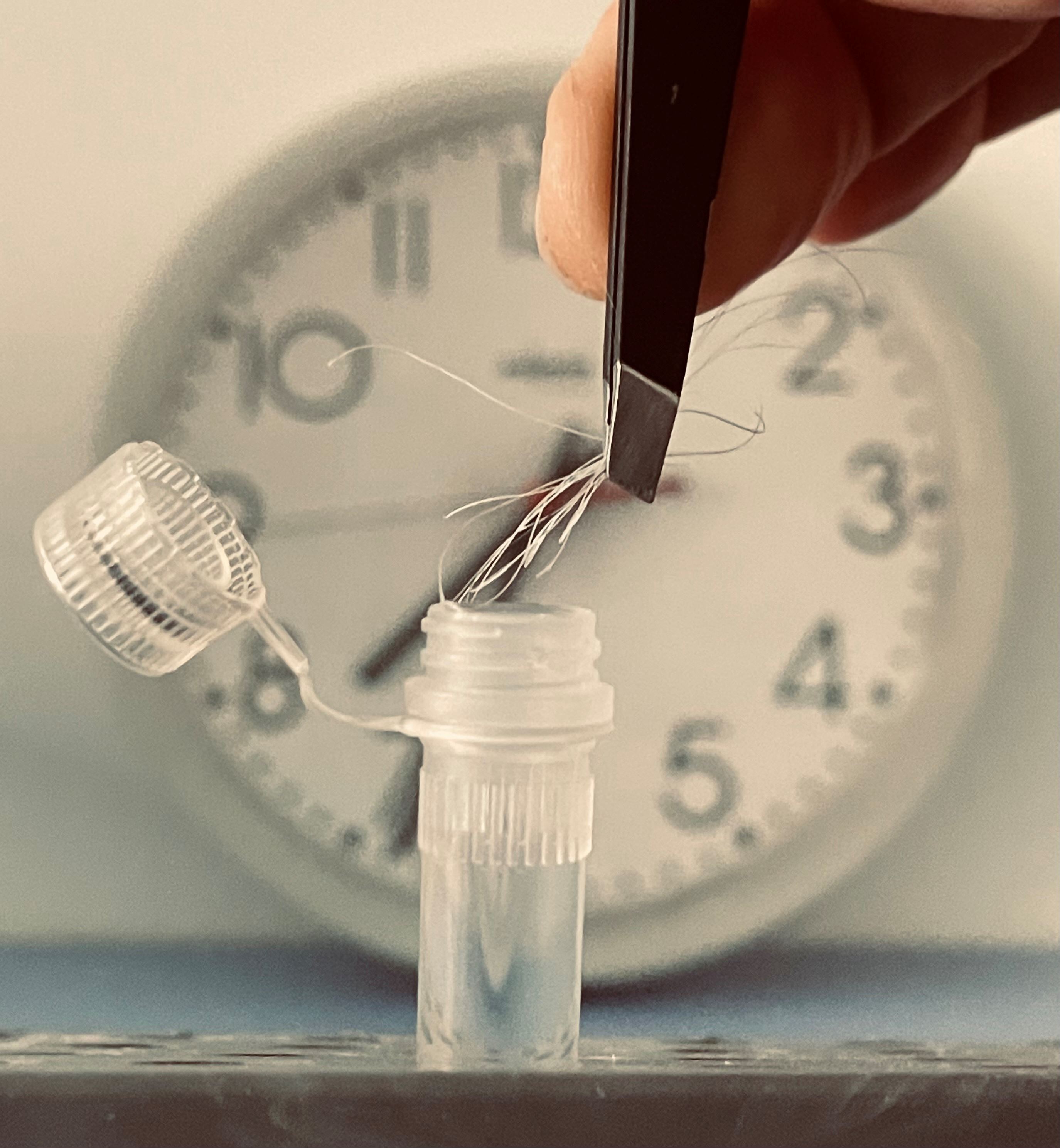
HairTime: A noninvasive assay for estimating circadian phase from a single hair sample
March 25, 2026
•
Proc Natl Acad Sci USA
Circadian clocks govern daily physiological and behavioral processes and are crucial for health; disruptions can lead to various diseases. The circadian phase of entrainment—the phase of the internal circadian clock in relation to external environmental cycles—is influenced by both genetic and environmental factors, varies between individuals, and is reflected in daily behaviors such as sleep–wake patterns, cognitive performance, and physical activity. While circadian phase may also fluctuate within individuals, the dynamics and extent of such variation in daily life remain largely unexplored. The gold standard for circadian phase assessment, dim-light melatonin onset (DLMO), is impractical for large-scale studies, and blood-based molecular biomarkers, while promising, are limited in feasibility. To address these challenges, we developed HairTime, a noninvasive assay that estimates circadian phase from a single daytime hair sample. Developed and evaluated in two steps—a training and a validation study—HairTime demonstrated strong predictive power compared to DLMO. Suitable for large-scale studies, it was assessed using over 4,000 samples. Circadian phase estimations showed a normal distribution and were associated with age, sex, and notably, work schedules, with earlier timing on workdays, suggesting that societal factors can modulate internal rhythms. Together, these findings establish HairTime as a promising tool for assessing circadian phase in research and lay the foundation for future applications in personalized chronotherapy.
HairTime: A noninvasive assay for estimating circadian phase from a single hair sample
March 25, 2026
•
Proc Natl Acad Sci USA
Circadian clocks govern daily physiological and behavioral processes and are crucial for health; disruptions can lead to various diseases. The circadian phase of entrainment—the phase of the internal circadian clock in relation to external environmental cycles—is influenced by both genetic and environmental factors, varies between individuals, and is reflected in daily behaviors such as sleep–wake patterns, cognitive performance, and physical activity. While circadian phase may also fluctuate within individuals, the dynamics and extent of such variation in daily life remain largely unexplored. The gold standard for circadian phase assessment, dim-light melatonin onset (DLMO), is impractical for large-scale studies, and blood-based molecular biomarkers, while promising, are limited in feasibility. To address these challenges, we developed HairTime, a noninvasive assay that estimates circadian phase from a single daytime hair sample. Developed and evaluated in two steps—a training and a validation study—HairTime demonstrated strong predictive power compared to DLMO. Suitable for large-scale studies, it was assessed using over 4,000 samples. Circadian phase estimations showed a normal distribution and were associated with age, sex, and notably, work schedules, with earlier timing on workdays, suggesting that societal factors can modulate internal rhythms. Together, these findings establish HairTime as a promising tool for assessing circadian phase in research and lay the foundation for future applications in personalized chronotherapy.
Intended isocaloric time-restricted eating shifts circadian clocks but does not improve cardiometabolic health in women with overweight
October 29, 2025
•
Science Translational Medicine
Beeke Peters, Julia Schwarz, Bettina Schuppelius, Agnieszka Ottawa, Daniela A Koppold, Daniela Weber, Nico Steckhan, Knut Mai, Tilman Grune, Andreas F H Pfeiffer, Andreas Michalsen, Achim Kramer, Olga Pivovarova-Ramich
Time-restricted eating (TRE) is a promising strategy to improve metabolic outcomes. However, it remains unclear whether TRE has cardiometabolic benefits in an isocaloric setting and whether its effects depend on the eating timing. We conducted a randomized crossover trial in 31 women with overweight or obesity to directly compare the effects of a 2-week early TRE (eTRE; eating from 8:00 to 16:00) and a 2-week late TRE (lTRE; eating from 13:00 to 21:00) on insulin sensitivity, cardiometabolic risk factors, and the internal circadian phase. During the restricted 8-hour eating period, participants were asked to consume their habitual food quality and quantity. Insulin sensitivity did not differ between (-0.07; 95% CI, -0.77 to 0.62; P = 0.60) or within (eTRE: 0.31; 95% CI, -0.14 to 0.76; P = 0.11; lTRE: 0.19; 95% CI, -0.22 to 0.60; P = 0.25) interventions. Twenty-four-hour glucose, lipid, inflammatory, and oxidative stress markers showed no clinically meaningful between- or within-intervention differences. Participants demonstrated high timely adherence (eTRE, 96.5%; lTRE, 97.7%), unchanged dietary composition and physical activity, minor daily calorie deficit (eTRE, -167 kilocalories/day), and weight loss (eTRE, -1.08 kilograms; lTRE, -0.44 kilograms). In lTRE, the circadian phase in blood monocytes (24 minutes; 95% CI, -5 to 54 minutes; P = 0.10) and sleep midpoint (15 minutes; 95% CI, 7 to 23 minutes; P< 0.001) occurred later compared with eTRE. Overall, in an intended isocaloric setting, neither eTRE nor lTRE improves insulin sensitivity or other cardiometabolic traits, despite a shift of internal circadian clocks.
Hepatic metabolic reprogramming in male mice during short-term caloric restriction involves enhanced glucocorticoid rhythms
December 11, 2025
•
Nature
Konstantinos Makris, Vlera Fonda, Fania Feby Ramadhani, Lina Fadel, Morgane Davezac, Bertrand Payet, Ioannis K Deligiannis, Liwei Zhang, Teresa Horn, Laura Heimerl, Céline Jouffe, Marjolein Heddes, Celia P Martinez-Jimenez, Fabiana Quagliarini, N Henriette Uhlenhaut
Caloric restriction prolongs lifespan and preserves health across species, with feeding times synchronized to day–night cycles further maximizing benefits. However, the mechanisms linking diet, diurnal rhythms, and lifespan remain unclear. In mice, the time point most strongly tied to dietary effects on lifespan coincides with the peak of glucocorticoid secretion (ZT12, lights-off). Caloric restriction raises circulating glucocorticoid hormone levels, implicating these signals as candidate mediators for its benefits. Here we show that in the liver, the glucocorticoid receptor (GR) is required for the metabolic response to caloric restriction. Hepatocyte-specific GR mutant males fail to mount this response, indicating that increased glucocorticoid amplitude is necessary for the adaptation. Using multiomics, we find that nutrient deprivation elicits a nuclear switch from active STAT signaling to increased FOXO1 activity, enabling GR to activate diet-specific gene expression programs. Our results suggest that glucocorticoid rhythms are crucial for caloric restriction-induced metabolic reprogramming.
Ventilator-induced Lung Injury Is Modulated by the Circadian Clock
June 1, 2023
•
AJRCCM
Matthias Felten, Sebastian Ferencik, Luiz-Gustavo Teixeira Alves, Eleftheria Letsiou, Jasmin Lienau, Holger C Müller-Redetzky, Alina Katharina Langenhagen, Anne Voß, Kristina Dietert, Olivia Kershaw, Achim D Gruber, Laura Michalick, Wolfgang M Kuebler, Bharath Ananthasubramaniam, Bert Maier, Henriette Uhlenhaut, Achim Kramer, Martin Witzenrath
Rationale: Mechanical ventilation (MV) is life-saving but may evoke ventilator-induced lung injury (VILI). Objectives: To explore how the circadian clock modulates severity of murine VILI via the core clock component BMAL1 (basic helix-loop-helix ARNT like 1) in myeloid cells. Methods: Myeloid cell BMAL1-deficient (LysM (lysozyme 2 promoter/enhancer driving cre recombinase expression)Bmal1-/-) or wild-type control (LysMBmal1+/+) mice were subjected to 4 hours MV (34 ml/kg body weight) to induce lung injury. Ventilation was initiated at dawn or dusk or in complete darkness (circadian time [CT] 0 or CT12) to determine diurnal and circadian effects. Lung injury was quantified by lung function, pulmonary permeability, blood gas analysis, neutrophil recruitment, inflammatory markers, and histology. Neutrophil activation and oxidative burst were analyzed ex vivo. Measurements and Main Results: In diurnal experiments, mice ventilated at dawn exhibited higher permeability and neutrophil recruitment compared with dusk. Experiments at CT showed deterioration of pulmonary function, worsening of oxygenation, and increased mortality at CT0 compared with CT12. Wild-type neutrophils isolated at dawn showed higher activation and reactive oxygen species production compared with dusk, whereas these day-night differences were dampened in LysMBmal1-/- neutrophils. In LysMBmal1-/- mice, circadian variations in VILI severity were dampened and VILI-induced mortality at CT0 was reduced compared with LysMBmal1+/+ mice. Conclusions: Inflammatory response and lung barrier dysfunction upon MV exhibit diurnal variations, regulated by the circadian clock. LysMBmal1-/- mice are less susceptible to ventilation-induced pathology and lack circadian variation of severity compared with LysMBmal1+/+ mice. Our data suggest that the internal clock in myeloid cells is an important modulator of VILI.
Circadian rhythm disruption in critically ill patients
March 14, 2023
•
Acta Physiologica
Matthias Felten, Christof Dame, Gunnar Lachmann, Claudia Spies, Kerstin Rubarth, Felix Balzer, Achim Kramer, Martin Witzenrath
Patients admitted to the intensive care unit (ICU) are in need of continuous organ replacement strategies and specialized care, for example because of neurological dysfunction, cardio-pulmonary instability, liver or kidney failure, trauma, hemorrhagic or septic shock or even preterm birth. The 24-h nursing and care interventions provided to critically ill patients significantly limit resting and/or recovery phases. Consecutively, the patient's endogenous circadian rhythms are misaligned and disrupted, which in turn may interfere with their critical condition. A more thorough understanding of the complex interactions of circadian effectors and tissue-specific molecular clocks could therefore serve as potential means for enhancing personalized treatment in critically ill patients, conceivably restoring their circadian network and thus accelerating their physical and neurocognitive recovery. This review addresses the overarching issue of how circadian rhythms are affected and disturbed in critically ill newborns and adults in the ICU, and whether the conflicting external or environmental cues in the ICU environment further promote disruption and thus severity of illness. We direct special attention to the influence of cell-type specific molecular clocks on with severity of organ dysfunctions such as severity of brain dysfunction, pneumonia- or ventilator-associated lung inflammation, cardiovascular instability, liver and kidney failure, trauma, and septic shock. Finally, we address the potential of circadian rhythm stabilization to enhance and accelerate clinical recovery.
Potential effects of shift work on skin autoimmune diseases
February 14, 2023
•
Frontiers in Immunology
Sarah Stenger, Hanna Grasshoff, Jennifer Elisabeth Hundt, Tanja Lange
Shift work is associated with systemic chronic inflammation, impaired host and tumor defense and dysregulated immune responses to harmless antigens such as allergens or auto-antigens. Thus, shift workers are at higher risk to develop a systemic autoimmune disease and circadian disruption with sleep impairment seem to be the key underlying mechanisms. Presumably, disturbances of the sleep-wake cycle also drive skin-specific autoimmune diseases, but epidemiological and experimental evidence so far is scarce. This review summarizes the effects of shift work, circadian misalignment, poor sleep, and the effect of potential hormonal mediators such as stress mediators or melatonin on skin barrier functions and on innate and adaptive skin immunity. Human studies as well as animal models were considered. We will also address advantages and potential pitfalls in animal models of shift work, and possible confounders that could drive skin autoimmune diseases in shift workers such as adverse lifestyle habits and psychosocial influences. Finally, we will outline feasible countermeasures that may reduce the risk of systemic and skin autoimmunity in shift workers, as well as treatment options and highlight outstanding questions that should be addressed in future studies.
Detecting and exploiting the circadian clock in rheumatoid arthritis
August 23, 2023
•
Acta Physiologica
Siska Wilantri, Hanna Grasshoff, Tanja Lange, Timo Gaber, Luciana Besedovsky, Frank Buttgereit
Over the past four decades, research on 24-h rhythms has yielded numerous remarkable findings, revealing their genetic, molecular, and physiological significance for immunity and various diseases. Thus, circadian rhythms are of fundamental importance to mammals, as their disruption and misalignment have been associated with many diseases and the abnormal functioning of many physiological processes. In this article, we provide a brief overview of the molecular regulation of 24-h rhythms, their importance for immunity, the deleterious effects of misalignment, the link between such pathological rhythms and rheumatoid arthritis (RA), and the potential exploitation of chronobiological rhythms for the chronotherapy of inflammatory autoimmune diseases, using RA as an example.


