Unsere innere Uhr verstehen, Gesundheit verbessern
Warum circadiane Rhythmen für Gesundheit und Krankheit entscheidend sind
Unsere innere Uhr steuert grundlegende physiologische Prozesse im gesamten Körper. Gerät diese zeitliche Orchestrierung aus dem Gleichgewicht, können Krankheiten entstehen, häufig lange bevor erste Symptome erkennbar sind. Gleichzeitig eröffnet sich darin eine wegweisende Chance: Ein vertieftes Verständnis der Mechanismen des circadianen Timings kann grundlegend verändern, wie wir Krankheiten vorbeugen, diagnostizieren und behandeln.
Unser Konsortium begreift die circadiane Biologie als ein verbindendes Rahmenkonzept für die Medizin der Zukunft. Wir untersuchen, wie gestörte zeitliche Abläufe zur Krankheitsentstehung beitragen, und entwickeln Strategien, um die innere Uhr zu messen („Detecting“), zu beeinflussen („Targeting“) und therapeutisch zu nutzen („Exploiting“). Damit möchten wir den Weg zu einer Medizin ebnen, die prädiktiv, personalisiert und präzise an den endogenen Rhythmen des Körpers ausgerichtet ist.
Die Stimmen von TRR 418

Wir sehen in der circadianen Medizin ein zentrales Zukunftsfeld, das medizinisches Denken und Handeln neu prägen kann. Unsere Vision ist es, medizinische Strategien mit der inneren Uhr des Körpers zu synchronisieren.
Achim Kramer
Sprecher

Wir stützen uns auf eine solide wissenschaftliche Basis, um zu verstehen, wie zeitliche Abläufe Physiologie und Krankheitsprozesse beeinflussen. Gemeinsam entschlüsseln wir Mechanismen, die präzise, evidenzbasierte Interventionen ermöglichen.
Henrik Oster
Stellvertretender Sprecher

Täglich sehen wir, wie gestörte circadiane Rhythmen Genesung und Wohlbefinden beeinflussen. Durch ihre Wiederherstellung wollen wir Versorgung und Therapieergebnisse verbessern.
Claudia Spies
Stellvertretende Sprecherin
Unsere Projekte
Unsere Projekte übersetzen die Prinzipien der circadianen Medizin in klar definierte Forschungsfragen. Jedes Projekt fokussiert sich auf ein spezifisches biologisches System, einen Krankheitskontext oder eine methodische Herausforderung und trägt zugleich zu einem gemeinsamen, transdisziplinären Ansatz bei. Zusammen verbinden sie mechanistische Erkenntnisse, klinische Forschung und datengetriebene Methoden, um circadiane Diagnostik, Interventionen und Therapien voranzubringen. Entdecken Sie unsere Projekte und erfahren Sie, wie circadiane Medizin in der Praxis erforscht wird.
B02
Circadiane Desynchronisation und epigenetische Veränderung: Wechselwirkungen bei der Entwicklung und Auflösung von mit metabolischer Dysfunktion assoziierter Steatohepatitis
Circadiane Desynchronisation und epigenetische Veränderung: Wechselwirkungen bei der Entwicklung und Auflösung von mit metabolischer Dysfunktion assoziierter Steatohepatitis
C01
Individualisierte datengesteuerte Lichtintervention bei Patienten auf der Intensivstation
Individualisierte datengesteuerte Lichtintervention bei Patienten auf der Intensivstation
A01
Mechanismen der circadianen Impfantworten bei Menschen und Mäusen
Mechanismen der circadianen Impfantworten bei Menschen und Mäusen
Die Publikationen von TRR 418
Die Publikationen von TRR 418 bilden die wissenschaftliche Grundlage der Arbeiten des Konsortiums in der circadianen Medizin. Sie geben vertiefte Einblicke in experimentelle, klinische und datenbasierte Studien, die unser Verständnis der circadianen Zeitsteuerung in Gesundheit und Krankheit voranbringen. Entdecken Sie unsere Publikationen und gewinnen Sie Einblick in die Evidenz, Methoden und wissenschaftlichen Konzepte hinter dieser Forschung.
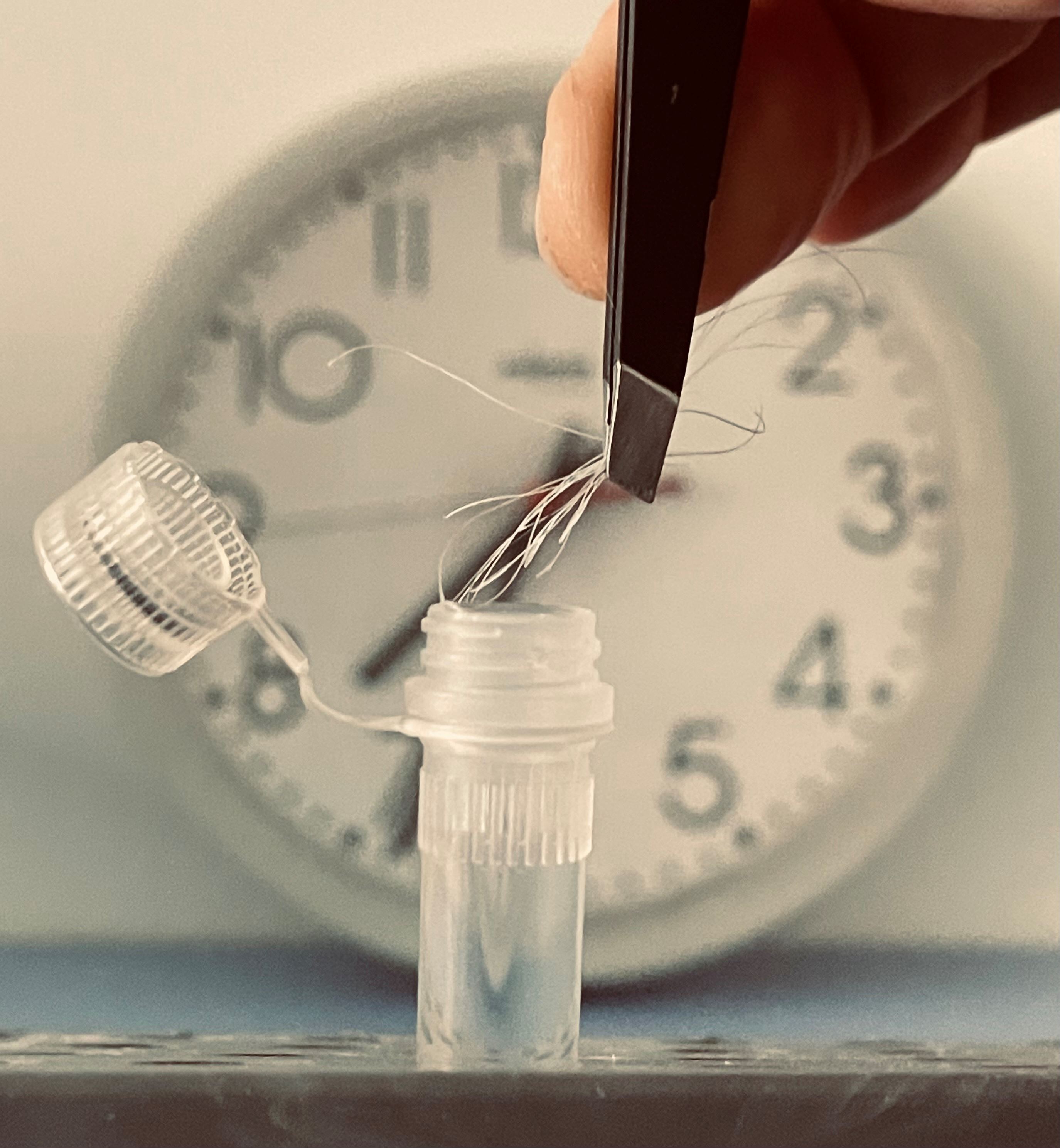
HairTime: A noninvasive assay for estimating circadian phase from a single hair sample
March 25, 2026
•
Proc Natl Acad Sci USA
Circadian clocks govern daily physiological and behavioral processes and are crucial for health; disruptions can lead to various diseases. The circadian phase of entrainment—the phase of the internal circadian clock in relation to external environmental cycles—is influenced by both genetic and environmental factors, varies between individuals, and is reflected in daily behaviors such as sleep–wake patterns, cognitive performance, and physical activity. While circadian phase may also fluctuate within individuals, the dynamics and extent of such variation in daily life remain largely unexplored. The gold standard for circadian phase assessment, dim-light melatonin onset (DLMO), is impractical for large-scale studies, and blood-based molecular biomarkers, while promising, are limited in feasibility. To address these challenges, we developed HairTime, a noninvasive assay that estimates circadian phase from a single daytime hair sample. Developed and evaluated in two steps—a training and a validation study—HairTime demonstrated strong predictive power compared to DLMO. Suitable for large-scale studies, it was assessed using over 4,000 samples. Circadian phase estimations showed a normal distribution and were associated with age, sex, and notably, work schedules, with earlier timing on workdays, suggesting that societal factors can modulate internal rhythms. Together, these findings establish HairTime as a promising tool for assessing circadian phase in research and lay the foundation for future applications in personalized chronotherapy.
HairTime: A noninvasive assay for estimating circadian phase from a single hair sample
March 25, 2026
•
Proc Natl Acad Sci USA
Circadian clocks govern daily physiological and behavioral processes and are crucial for health; disruptions can lead to various diseases. The circadian phase of entrainment—the phase of the internal circadian clock in relation to external environmental cycles—is influenced by both genetic and environmental factors, varies between individuals, and is reflected in daily behaviors such as sleep–wake patterns, cognitive performance, and physical activity. While circadian phase may also fluctuate within individuals, the dynamics and extent of such variation in daily life remain largely unexplored. The gold standard for circadian phase assessment, dim-light melatonin onset (DLMO), is impractical for large-scale studies, and blood-based molecular biomarkers, while promising, are limited in feasibility. To address these challenges, we developed HairTime, a noninvasive assay that estimates circadian phase from a single daytime hair sample. Developed and evaluated in two steps—a training and a validation study—HairTime demonstrated strong predictive power compared to DLMO. Suitable for large-scale studies, it was assessed using over 4,000 samples. Circadian phase estimations showed a normal distribution and were associated with age, sex, and notably, work schedules, with earlier timing on workdays, suggesting that societal factors can modulate internal rhythms. Together, these findings establish HairTime as a promising tool for assessing circadian phase in research and lay the foundation for future applications in personalized chronotherapy.
Unsere News & Events
.jpg)
.jpeg)