Discover our research
At TRR 418, our research reveals new insights in circadian medicine. These discoveries are shared through our publications, offering a closer look at experimental, clinical, and data-driven studies that help us understand how circadian timing affects health and disease. Dive into our publications to see the evidence, methods, and ideas.
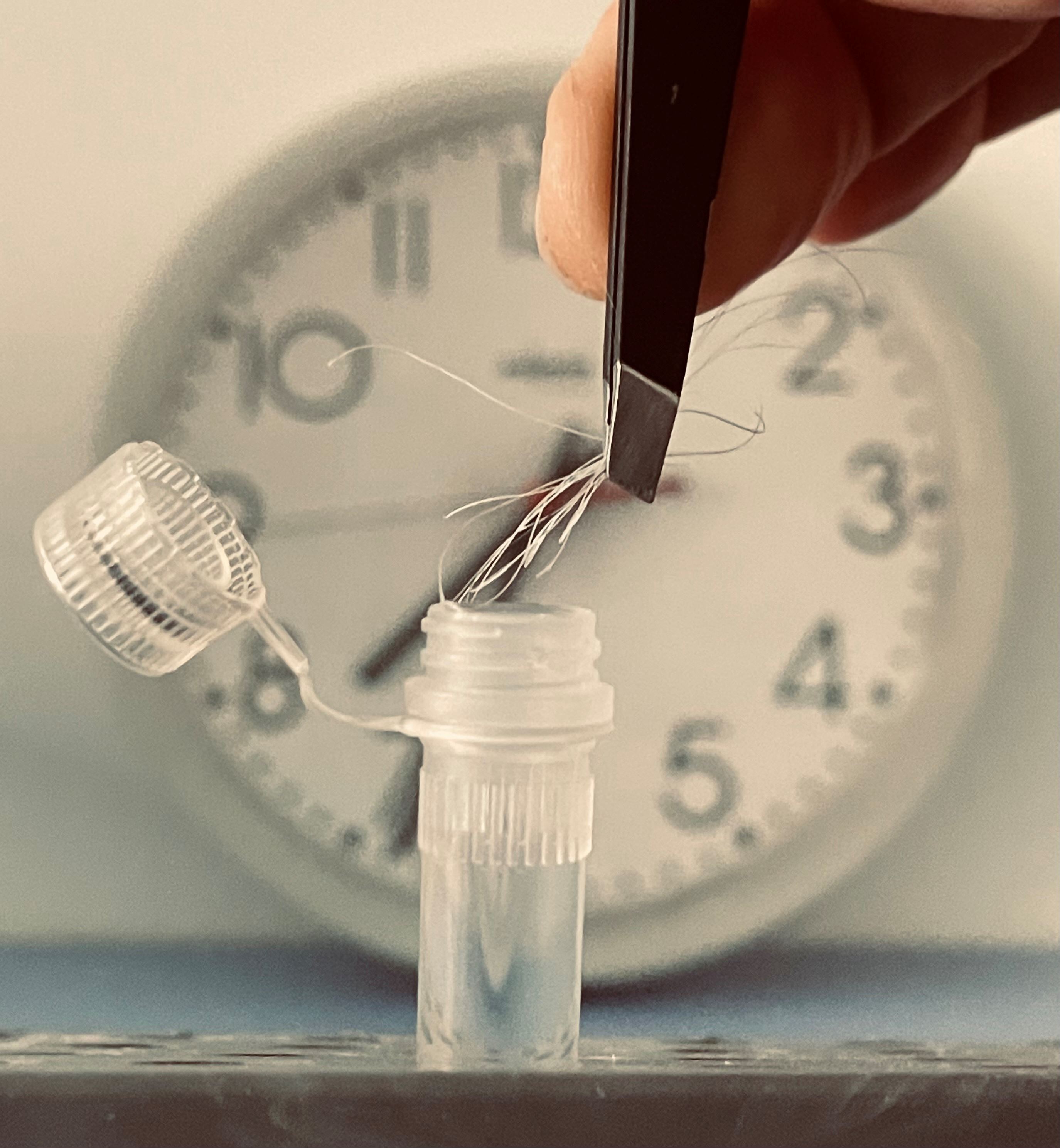
HairTime: A noninvasive assay for estimating circadian phase from a single hair sample
March 25, 2026
•
Proc Natl Acad Sci USA
Circadian clocks govern daily physiological and behavioral processes and are crucial for health; disruptions can lead to various diseases. The circadian phase of entrainment—the phase of the internal circadian clock in relation to external environmental cycles—is influenced by both genetic and environmental factors, varies between individuals, and is reflected in daily behaviors such as sleep–wake patterns, cognitive performance, and physical activity. While circadian phase may also fluctuate within individuals, the dynamics and extent of such variation in daily life remain largely unexplored. The gold standard for circadian phase assessment, dim-light melatonin onset (DLMO), is impractical for large-scale studies, and blood-based molecular biomarkers, while promising, are limited in feasibility. To address these challenges, we developed HairTime, a noninvasive assay that estimates circadian phase from a single daytime hair sample. Developed and evaluated in two steps—a training and a validation study—HairTime demonstrated strong predictive power compared to DLMO. Suitable for large-scale studies, it was assessed using over 4,000 samples. Circadian phase estimations showed a normal distribution and were associated with age, sex, and notably, work schedules, with earlier timing on workdays, suggesting that societal factors can modulate internal rhythms. Together, these findings establish HairTime as a promising tool for assessing circadian phase in research and lay the foundation for future applications in personalized chronotherapy.
HairTime: A noninvasive assay for estimating circadian phase from a single hair sample
March 25, 2026
•
Proc Natl Acad Sci USA
Circadian clocks govern daily physiological and behavioral processes and are crucial for health; disruptions can lead to various diseases. The circadian phase of entrainment—the phase of the internal circadian clock in relation to external environmental cycles—is influenced by both genetic and environmental factors, varies between individuals, and is reflected in daily behaviors such as sleep–wake patterns, cognitive performance, and physical activity. While circadian phase may also fluctuate within individuals, the dynamics and extent of such variation in daily life remain largely unexplored. The gold standard for circadian phase assessment, dim-light melatonin onset (DLMO), is impractical for large-scale studies, and blood-based molecular biomarkers, while promising, are limited in feasibility. To address these challenges, we developed HairTime, a noninvasive assay that estimates circadian phase from a single daytime hair sample. Developed and evaluated in two steps—a training and a validation study—HairTime demonstrated strong predictive power compared to DLMO. Suitable for large-scale studies, it was assessed using over 4,000 samples. Circadian phase estimations showed a normal distribution and were associated with age, sex, and notably, work schedules, with earlier timing on workdays, suggesting that societal factors can modulate internal rhythms. Together, these findings establish HairTime as a promising tool for assessing circadian phase in research and lay the foundation for future applications in personalized chronotherapy.
Circadian screening of neutrophils identifies therapeutic targets in multiple sclerosis
June 3, 2026
•
PNAS
Francesco De Virgiliisa, Coline Barnouda, Wenyan Hea, Qun Zenga, Robert Picka, Tianyue Suna, Stéphane Jemelina, Valeria Maria Olivaa, Tiphaine Furlana, Carmen Picon-Muñoza, Doron Merklera and Christoph Scheiermann
Circadian rhythms are intrinsic time-keeping mechanisms that play a critical role in tuning immunity. Here, we investigated the impact of circadian rhythms on the pathogenesis of experimental autoimmune encephalomyelitis (EAE), a mouse model for multiple sclerosis (MS). We demonstrate that circulating neutrophils in blood significantly increase early in EAE, prior to symptoms onset. Importantly, we found that these cells infiltrate the central nervous system (CNS) in a time-of-day (ToD)-dependent manner, with increased infiltration at the onset of the behavioral active phase of the mice (evening). Transcriptomic analysis of CNS-infiltrating neutrophils revealed distinct ToD-dependent gene expression profiles, which identified Formyl peptide receptor 2 (FPR2) as a potential therapeutic candidate, since pharmacological inhibition of FPR2 led to reduced EAE disease severity. Furthermore, combinatorial treatment with a drug that targets VLA-4 (used in clinical practice under the trade name Natalizumab to treat MS) led to additive effects, substantially reducing EAE symptoms. Together, these findings highlight the importance of circadian immune cell dynamics during EAE development and provide a characterization of the circadian immune landscape in an animal model of MS, identifying potential targets for MS therapies.
Aberrant insula activity to negative and reduced learning from positive feedback underlie maladaptive self-beliefs in depression
August 6, 2026
•
Translational Psychiatry - Nature
Nora Czekalla, Alexander Schröder, Annalina V. Mayer, Janine Stierand, David S. Stolz, Tobias Kube, Christoph W. Korn, Ines Wilhelm, Jan Philipp Klein, Frieder M. Paulus, Sören Krach & Laura Müller-Pinzler
Maladaptive self-beliefs are a core symptom of major depressive disorder. These beliefs are perpetuated by a negatively biased integration of self-related feedback. Understanding the neurocomputational mechanisms of biased belief updating may help to counteract maladaptive beliefs and the maintenance of depression.
CLOCK/BMAL1 interactome uncovers homeodomain factors as tissue regulators
August 8, 2026
•
Nature Cell Biology
Fatih Aygenli, Lukas A. Huschet, Tanja Popp, Andrea Ribeiro, Darina Barkhatova, Céline Jouffe, Ricardo Trozzo, Jerome S. Menet, Roland Rad, Kenneth A. Dyar, Alicia K. Michael & Maria S. Robles
Circadian clocks underlie daily rhythms in physiology by coordinating temporal patterns of gene expression and protein function throughout the body. At the core of this system in mammals is CLOCK/BMAL1, a ubiquitously expressed heterodimeric transcription factor complex that orchestrates tissue-specific circadian gene expression. The basis for this specificity remains unclear, but tissue-specific interactions at chromatin could provide one. Here we used chromatin immunoprecipitation coupled to mass spectrometry to map CLOCK/BMAL1-associated protein complexes on chromatin in mouse liver, kidney and lung. We detected 1,510 associated proteins, most of which were tissue-specific and not explained by protein abundance. Among these, we identified the homeodomain transcription factors PROX1, HNF1B and HOXA5 as tissue-enriched interactors that bind BMAL1, co-occupy most BMAL1 genomic sites and establish organ-restricted circadian transcription. Our findings demonstrate that tissue-specific transcription factors confer cellular identity on the core clock, thereby contributing to organ-specific patterns of rhythmic gene expression.
A Lentiviral Fluorescent Reporter to Study Circadian Rhythms in Single Cells
April 27, 2026
•
Journal of Biological Rhythms
Christian H. Gabriel, Luis Lehmann, Joana Ahlburg, and Achim Kramer
Circadian rhythms—self-sustained, ~24-h oscillations in transcript and protein levels—are generated by a cell-autonomous molecular clock. These rhythms shape how individual cells respond to external signals, influencing key decisions such as differentiation and apoptosis. However, current tools for visualizing circadian rhythms at the single-cell level often rely on genomic engineering and clonal expansion, limiting their accessibility and applicability. We present fluorescent circadian reporters based on the murine REVERBα/Nr1d1 gene, delivered via lentiviral transduction and compatible with time-lapse single-cell microscopy. These reporters produce oscillatory signals that depend on a functional circadian clock and can be used to determine a cell’s circadian dynamics parameters, such as circadian phase. Their simple and efficient delivery should make them suitable for a wide variety of cell types, greatly expanding opportunities to study single-cell circadian dynamics and their impact across diverse biological processes and systems.
Adiponectin modulates the diurnal hepatic transcriptome and energy metabolism in male mice
April 14, 2026
•
Endocrine Connections
Misa Hirose, Enrique Calvo, Violetta Pilorz, Meike Kaehler, Ingolf Cascorbi, Inga Nagel, Leonardo Vinicius Monteiro de Assis, Henrik Oster
Adiponectin is an adipocyte-derived hormone with insulin-sensitizing and lipid-lowering effects. Its expression and circulating levels show pronounced variation across the day, which opens the possibility that adiponectin influences metabolic programs in target tissues, such as the liver in a time-of-day dependent manner. To test this, we compared liver circadian transcriptome profiles (with sampling at 4-h intervals) between adiponectin-deficient (ADQ-KO) and wild-type (ADQ-WT) mice. Adiponectin loss led to tonic (i.e. time-independent) transcriptional changes in the liver with 1,393 differentially expressed genes (518 up- and 875 downregulated). These included upregulation of chromatin and RNA processing pathways and downregulation of immune and mitochondrial metabolic genes. At the same time, circadian analysis identified a marked reprogramming of transcriptome rhythms in ADQ-KO livers with changes in MESOR (n = 3,369 transcripts), amplitude (n = 386), and phase of gene expression (n = 603). Genes associated with mitochondrial respiration and fatty acid metabolism showed reduced rhythm amplitude and MESOR, whereas glycolytic genes exhibited increased MESOR. One of the identified adiponectin candidate targets and a regulator of hepatic metabolism, Hif1a, was further studied by functional assays in murine hepatocytes. Pharmacological adiponectin receptor activation promoted glycolysis and mitochondrial respiration under normoxia, but these effects were attenuated under hypoxia mimicry, consistent with HIF1a-dependent interference. These findings suggest adiponectin as a regulator of liver circadian metabolism, modulating both the timing and magnitude of energy-related gene expression programs, potentially in part through a HIF1a-mediated mechanism.
Retinal ganglion cell degeneration in glaucoma disrupts HPA axis temporal organization and dampens corticosterone production
April 24, 2026
•
Journal of Neuroendocrinology
Pietra Souza Barsanele, Juliano Jefferson da Silva, Bryan Fellipe da Silva Cortes, Eliz Maria de Oliveira Furtado, José Cipolla-Neto, Leonardo Vinícius Monteiro de Assis, Maristela Oliveira Poletini, Maria Nathália Moraes
Glaucoma is a chronic optic neuropathy characterized by progressive vision loss. A previous study from our group showed that glaucoma-induced retinal degeneration disrupts photic signaling to the suprachiasmatic nucleus (SCN), altering the molecular components of the central circadian clock. Through its hypothalamic projections, the SCN entrains the hypothalamic–pituitary–adrenal (HPA) axis and drives the rhythmic secretion of corticosterone. In this study, we investigated whether central circadian clock disruption in glaucoma impacts the HPA axis and its downstream physiological rhythms. We analyzed the temporal profiles of key genes controlling the HPA axis in mice with glaucoma. The Crh gene expression was reduced in the paraventricular nucleus, while Crh-r1 exhibited a 10-h phase delay in the pituitary in response to glaucoma. Additionally, Pomc in the pituitary and Mc2r in the adrenal lost rhythmicity. The modulation of the daily rhythms of these key genes was associated with alterations in the diurnal rhythms of clock genes in the PVN, pituitary and adrenal gland. Glaucoma-induced phase shifts and amplitude alterations in the rhythmic expression of Per1, Per2, Nr1d1, and Bmal1 in the pituitary and adrenal gland, resulted in a temporal misalignment between the pituitary and adrenal rhythms. These molecular changes were associated with reduced corticosterone amplitude, suggesting impaired communication between central and peripheral clocks. Together, these findings demonstrate that glaucoma alters the temporal coordination of the HPA axis, highlighting how retinal dysfunction can propagate beyond the visual system to disturb systemic circadian and neuroendocrine regulation.


