Unsere Forschung entdecken
Bei TRR 418 eröffnen unsere Forschungen neue Einblicke in die circadiane Medizin. Diese Erkenntnisse werden in unseren Publikationen geteilt und bieten einen detaillierten Blick auf experimentelle, klinische und datenbasierte Studien, die zeigen, wie circadiane Rhythmen Gesundheit und Krankheit beeinflussen. Entdecken Sie unsere Publikationen, um die Evidenz, Methoden und Ideen hinter unserer Forschung kennenzulernen.
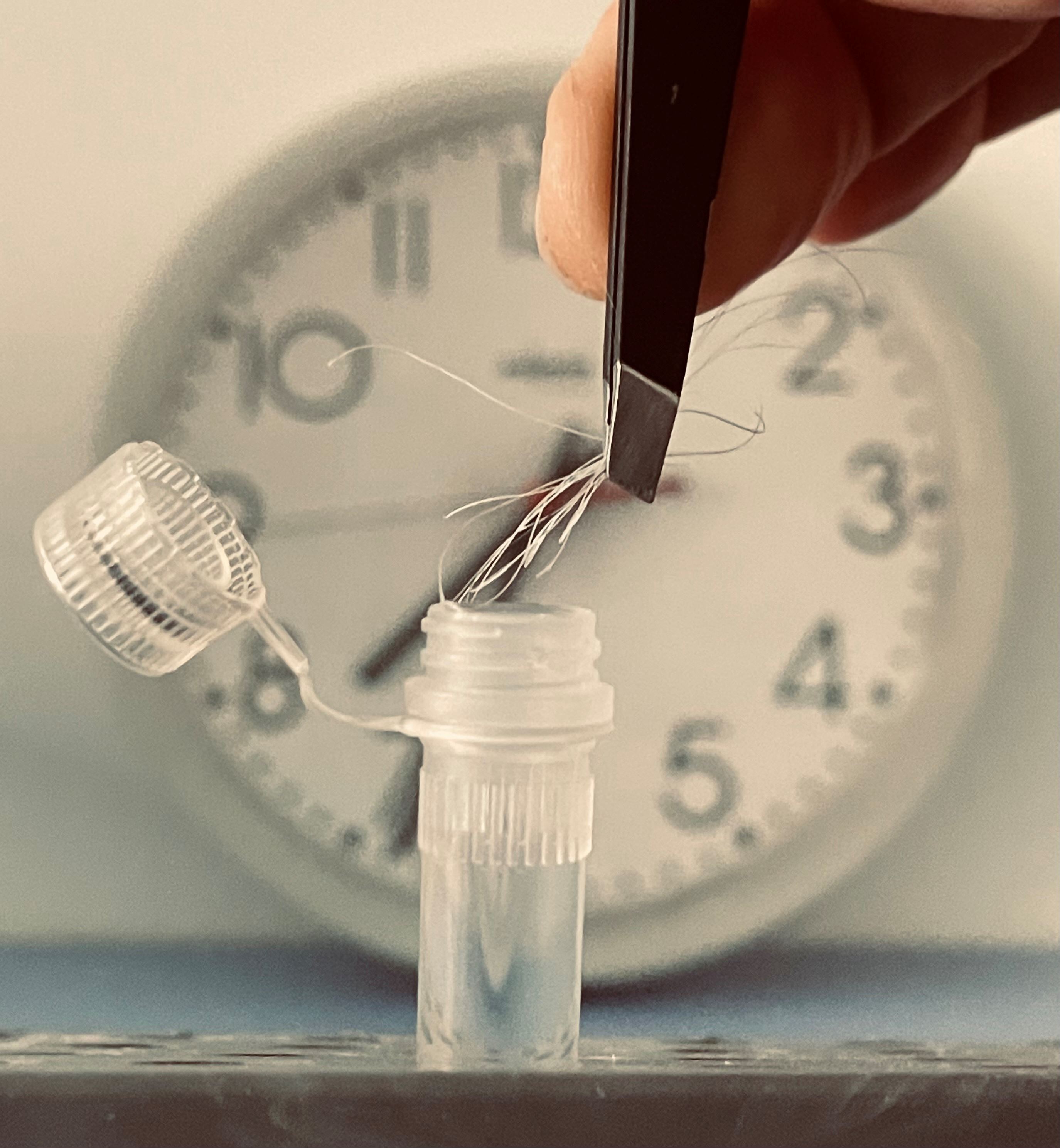
HairTime: A noninvasive assay for estimating circadian phase from a single hair sample
March 25, 2026
•
Proc Natl Acad Sci USA
Circadian clocks govern daily physiological and behavioral processes and are crucial for health; disruptions can lead to various diseases. The circadian phase of entrainment—the phase of the internal circadian clock in relation to external environmental cycles—is influenced by both genetic and environmental factors, varies between individuals, and is reflected in daily behaviors such as sleep–wake patterns, cognitive performance, and physical activity. While circadian phase may also fluctuate within individuals, the dynamics and extent of such variation in daily life remain largely unexplored. The gold standard for circadian phase assessment, dim-light melatonin onset (DLMO), is impractical for large-scale studies, and blood-based molecular biomarkers, while promising, are limited in feasibility. To address these challenges, we developed HairTime, a noninvasive assay that estimates circadian phase from a single daytime hair sample. Developed and evaluated in two steps—a training and a validation study—HairTime demonstrated strong predictive power compared to DLMO. Suitable for large-scale studies, it was assessed using over 4,000 samples. Circadian phase estimations showed a normal distribution and were associated with age, sex, and notably, work schedules, with earlier timing on workdays, suggesting that societal factors can modulate internal rhythms. Together, these findings establish HairTime as a promising tool for assessing circadian phase in research and lay the foundation for future applications in personalized chronotherapy.
HairTime: A noninvasive assay for estimating circadian phase from a single hair sample
March 25, 2026
•
Proc Natl Acad Sci USA
Circadian clocks govern daily physiological and behavioral processes and are crucial for health; disruptions can lead to various diseases. The circadian phase of entrainment—the phase of the internal circadian clock in relation to external environmental cycles—is influenced by both genetic and environmental factors, varies between individuals, and is reflected in daily behaviors such as sleep–wake patterns, cognitive performance, and physical activity. While circadian phase may also fluctuate within individuals, the dynamics and extent of such variation in daily life remain largely unexplored. The gold standard for circadian phase assessment, dim-light melatonin onset (DLMO), is impractical for large-scale studies, and blood-based molecular biomarkers, while promising, are limited in feasibility. To address these challenges, we developed HairTime, a noninvasive assay that estimates circadian phase from a single daytime hair sample. Developed and evaluated in two steps—a training and a validation study—HairTime demonstrated strong predictive power compared to DLMO. Suitable for large-scale studies, it was assessed using over 4,000 samples. Circadian phase estimations showed a normal distribution and were associated with age, sex, and notably, work schedules, with earlier timing on workdays, suggesting that societal factors can modulate internal rhythms. Together, these findings establish HairTime as a promising tool for assessing circadian phase in research and lay the foundation for future applications in personalized chronotherapy.
Challenges and Recommendations for Integrating Circadian Medicine in Critical Care: A Roadmap
December 20, 2025
•
Chest
Floor W Hiemstra, Liliana Bustos González, Lilian J Engelhardt, Laura Hancke, Luisa K Pilz, Amanda I Adler, Hassan S Dashti, Xavier Drouot, Gareth B Kitchen, Melissa P Knauert, Achim Kramer, Jonathan O Lipton, Alawi Luetz, Matthew B Maas, Nathan M Pajor, Sairam Parthasarathy, Claudia Spies, David J van Westerloo, Matthias Felten, Elizabeth B Klerman, David W Ray, Marc D Ruben, Till Roenneberg, Laura Kervezee
Background: Circadian rhythms are often severely disrupted in critically ill patients in the ICU. The ICU environment, characterized by irregular light-dark signals, continuous nutrition, and round-the-clock interventions, contributes to this disruption by providing weak and conflicting timing cues to the circadian system. Extensive scientific research has demonstrated that circadian rhythms play a vital role in regulating physiology and maintaining overall health. Therefore, integrating circadian principles into critical care may represent a promising strategy to improve patient outcomes in the ICU.
Research question: What are the key challenges of integrating circadian medicine into critical care, what steps can address these challenges, and which recommendations can guide future study designs and clinical implementation?
Study design and methods: We convened a 5-day workshop in September 2024 that brought together 24 international experts with backgrounds in circadian biology, critical care, and implementation science. Each day was organized around a predefined theme, with morning presentations and plenary discussions, and afternoons dedicated to drafting a list of Propositions and Recommendations in breakout groups. Propositions and Recommendations were finalized via a post-workshop survey requiring ≥ 75% agreement.
Results: This roadmap summarizes the discussions and outcomes of the workshop, structured around a set of Propositions and Recommendations, and provides a framework for building a robust evidence base for integrating circadian principles into ICU practice. Key recommendations include the development of circadian outcome measures tailored for use in the ICU and using standardized frameworks for evaluating the effect of circadian interventions in clinical trials.
Interpretation: Altogether, this roadmap provides an interdisciplinary framework resulting from a collaborative effort of ICU clinicians, circadian biologists, and implementation specialists, for building a robust evidence base for integrating circadian principles into ICU research and practice.
Keywords: ICU; circadian rhythms; critical care; critical illness; meeting report.
The role of the circadian clock in the development, progression, and treatment of non-alcoholic fatty liver disease
January 4, 2023
•
Acta Physiologica
Leonardo Vinicius Monteiro de Assis, Münevver Demir, Henrik Oster
The circadian clock comprises a cellular endogenous timing system coordinating the alignment of physiological processes with geophysical time. Disruption of circadian rhythms has been associated with several metabolic diseases. In this review, we focus on liver as a major metabolic tissue and one of the most well-studied organs with regard to circadian regulation. We summarize current knowledge about the role of local and systemic clocks and rhythms in regulating biological functions of the liver. We discuss how the disruption of circadian rhythms influences the development of non-alcoholic fatty liver disease (NAFLD) and non-alcoholic steatohepatitis (NASH). We also critically evaluate whether NAFLD/NASH may in turn result in chronodisruption. The last chapter focuses on potential roles of the clock system in prevention and treatment of NAFLD/NASH and the interaction of current NASH drug candidates with liver circadian rhythms and clocks. It becomes increasingly clear that paying attention to circadian timing may open new avenues for the optimization of NAFLD/NASH therapies and provide interesting targets for prevention and treatment of these increasingly prevalent disorders.
Keywords: NAFLD; NASH; chronotherapy; circadian rhythms; clock genes; liver; metabolic-associated fatty liver disease (MAFLD).
Nonalcoholic Steatohepatitis Disrupts Diurnal Liver Transcriptome Rhythms in Mice
December 31, 2023
•
CMGH
Leonardo Vinicius Monteiro de Assis, Münevver Demir, Henrik Oster
Background & aims: The liver ensures organismal homeostasis through modulation of physiological functions over the course of the day. How liver diseases such as nonalcoholic steatohepatitis (NASH) affect daily transcriptome rhythms in the liver remains elusive.
Methods: To start closing this gap, we evaluated the impact of NASH on the diurnal regulation of the liver transcriptome in mice. In addition, we investigated how stringent consideration of circadian rhythmicity affects the outcomes of NASH transcriptome analyses.
Results: Comparative rhythm analysis of the liver transcriptome from diet-induced NASH and control mice showed an almost 3-hour phase advance in global gene expression rhythms. Rhythmically expressed genes associated with DNA repair and cell-cycle regulation showed increased overall expression and circadian amplitude. In contrast, lipid and glucose metabolism-associated genes showed loss of circadian amplitude, reduced overall expression, and phase advances in NASH livers. Comparison of NASH-induced liver transcriptome responses between published studies showed little overlap (12%) in differentially expressed genes (DEGs). However, by controlling for sampling time and using circadian analytical tools, a 7-fold increase in DEG detection was achieved compared with methods without time control.
Conclusions: NASH had a strong effect on circadian liver transcriptome rhythms with phase- and amplitude-specific effects for key metabolic and cell repair pathways, respectively. Accounting for circadian rhythms in NASH transcriptome studies markedly improves DEG detection and enhances reproducibility.
Keywords: Circadian Bioinformatics; Circadian Clock; Circadian RNAseq; Energy Metabolism; Nonalcoholic Fatty Liver Disease (NAFLD).
The circadian neurobiology of reward
January 10, 2023
•
Acta Physiologica
Iwona Olejniczak, Kimberly Begemann, Ines Wilhelm, Henrik Oster
Circadian clocks are important regulators of physiology and behavior. In the brain, circadian clocks have been described in many centers of the central reward system. They affect neurotransmitter signaling, neuroendocrine circuits, and the sensitivity to external stimulation. Circadian disruption affects reward signaling, promoting the development of behavioral and substance use disorders. In this review, we summarize our current knowledge of circadian clock-reward crosstalk. We show how chronodisruption affects reward signaling in different animal models. We then translate these findings to circadian aspects of human reward (dys-) function and its clinical implications. Finally, we devise approaches to and challenges in implementing the concepts of circadian medicine in the therapy of substance use disorders.
Bmal1 deficiency in neutrophils alleviates symptoms induced by high-fat diet
March 21, 2025
•
iScience
Brinja Leinweber, Violetta Pilorz, Iwona Olejniczak, Ludmila Skrum, Kimberly Begemann, Isabel Heyde, Sarah Stenger, Christian David Sadik, Henrik Oster
Physiological processes, including metabolism and immune responses, are generated by the circadian clock, driven by clock genes. Disrupting circadian rhythms through a high-fat diet promotes obesity and inflammation. Studies show that deleting the clock gene, brain, and muscle ARNT-like 1 (Bmal1) in adipose tissue leads to overeating and weight gain. We now show that Bmal1 deletion in neutrophils protects against diet-induced obesity and reduces inflammatory macrophage infiltration into epididymal white adipose tissue (eWAT), despite increased food intake over 20 weeks of a high-fat diet. This protection is linked to enhanced energy expenditure, increased UCP1 expression in iBAT, improved insulin sensitivity, and altered expression of genes encoding chemokine receptors CXCR2, CXCR4, and the ligand Cxcl2 in eWAT. Our findings reveal a key role of Bmal1 in neutrophils in regulating high-fat diet-induced adipose inflammation and emphasize circadian regulation's importance in immuno-metabolic function.
Regulation of hedonic feeding rhythms by circadian clocks in leptin-receptive neurons
October 31, 2025
•
Molecular Metabolism
Jazmin Osorio-Mendoza, Jana-Thabea Kiehn, Sarah Stenger, Keno O Heinen, Laura Griewahn, Christiane E Koch, Undine Haferkamp, Violetta Pilorz, Johanna L Barclay, Parth Joshi, Lisbeth Harder, Olaf Jöhren, Peter Kühnen, Gregor Eichele, Henrik Oster
Objective: The circadian clock anticipates daily repetitive events to adapt physiological processes. In mammals, the circadian system consists of a master clock in the suprachiasmatic nucleus (SCN), which synchronizes subordinate tissue clocks, including extra-SCN central nervous system (CNS) clocks involved in functions such as sleep and appetite regulation. Appetite is controlled by both homeostatic and non-homeostatic (hedonic) circuits. Homeostatic appetite addresses energy needs, while hedonic feeding targets cravings for palatable, calorie-dense foods. The adipokine leptin is a major appetite regulator, interacting with the circadian clock. Although leptin's role in satiation through its action in the mediobasal hypothalamus (MBH) is well established, its involvement in the circadian regulation of feeding remains poorly understood. We hypothesized that circadian gating of leptin signaling in the CNS controls homeostatic and hedonic appetite across the day.
Methods: We analyzed food intake rhythms in mice with a loss of leptin (ob/ob mice) or clock function (Per1/2 or Bmal1 KO) and in mice with specific disruption of leptin circadian gating in the CNS (ObRb.Bmal1).
Results: We found that in leptin-deficient mice hedonic appetite increases specifically in the early rest phase. In contrast, clock-deficient Per1/2 mutant mice exhibit blunted rhythms in both hedonic and homeostatic appetite control. Finally, when clock function is disrupted in leptin-sensitive neurons only, mice display a lower sensitivity to palatable food, along with reduced initial weight gain and adipose hypertrophy under obesogenic diet conditions.
Conclusions: Our data describe a local clock-controlled central leptin gating mechanism that modulates hedonic food intake rhythms and impacts metabolic homeostasis.


